 Listicle
Best Aggregate Types for a Driveway Base That Lasts
Last Updated: November 14, 2026
Quick Summary
The best aggregate types for a driveway base are Type 1 MOT, Type 2 aggregate, crusher run and graded crushed stone, chosen to suit your ground conditions. Type 1 MOT suits most domestic driveways because it compacts to a firm, dense layer, while Type 2 aggregate is better where drainage matters more than pure strength.
- Type 1 MOT has enough fines to bind stones into a dense, interlocked layer under a roller.
- Type 2 aggregate is open-graded with fewer fines, so water passes through more freely.
- Crusher run compacts into a hard, stable layer and is one of the most economical options.
- A typical domestic driveway sub-base is 100-150mm deep, or around 200mm for heavier vehicles.
- Lay a geotextile membrane to stop fines mixing with the subgrade and prevent rutting.
Table of Contents
- Best Aggregate Types for a Driveway Base
- Type 1 vs Type 2 Aggregate
- Crusher Run for Driveway Base and Other Options
- Driveway Sub-Base Depth and How Much Aggregate for a Driveway
- Frequently Asked Questions
Best Aggregate Types for a Driveway Base
The best aggregate types for a driveway base are Type 1 MOT, Type 2 aggregate, crusher run and graded crushed stone, chosen to suit your ground conditions. At SA GRAB SERVICES, we supply and deliver these materials across the region.
A driveway base is the load-bearing layer beneath the surface. Get it right and the driveway lasts decades. Get it wrong and you will be re-doing it within two winters.
- Type 1 MOT for most domestic driveways, because it compacts to a firm, dense layer
- Type 2 aggregate where drainage matters more than pure strength
- Crusher run as a strong, economical base for heavier vehicle loads
- Graded crushed stone where you want a clean, open-graded layer
- Recycled concrete aggregate as a sustainable alternative, if the grading is consistent
Type 1 vs Type 2 Aggregate
Type 1 MOT and Type 2 aggregate are both crushed stone sub-base materials, graded to different envelopes. Type 1 is well-graded with a controlled spread of particle sizes and enough fines to bind the stones under a roller. Type 2 is more open-graded, with fewer fines, so water passes through more freely but it locks together less tightly.
The practical difference comes down to fines. Type 1 has enough fine material to fill the voids between larger stones, forming a dense, interlocked layer that spreads vehicle loads well. Type 2 has fewer fines, so voids stay open; that improves drainage but reduces density and stability under load.
| Feature | Type 1 MOT | Type 2 Aggregate |
|---|---|---|
| Grading | Well-graded, more fines | Open-graded, fewer fines |
| Compaction | Compacts to a firm, dense layer | Locks together but stays more open |
| Drainage | Moderate | Better |
| Best for | Most domestic driveways | Wet ground, slopes, drainage-led sites |
| Stability under load | High | Good, but less dense |
A common pattern is to use Type 1 as the main load-bearing sub-base and reserve Type 2 for sites where standing water or a slope makes drainage the priority.
Watch out: Type 1 and Type 2 are not interchangeable just because both are sold as sub-base. Substituting Type 2 where the specification calls for Type 1 loses density and load spread, and the surface layer above is more likely to rut.
Crusher Run for Driveway Base and Other Options
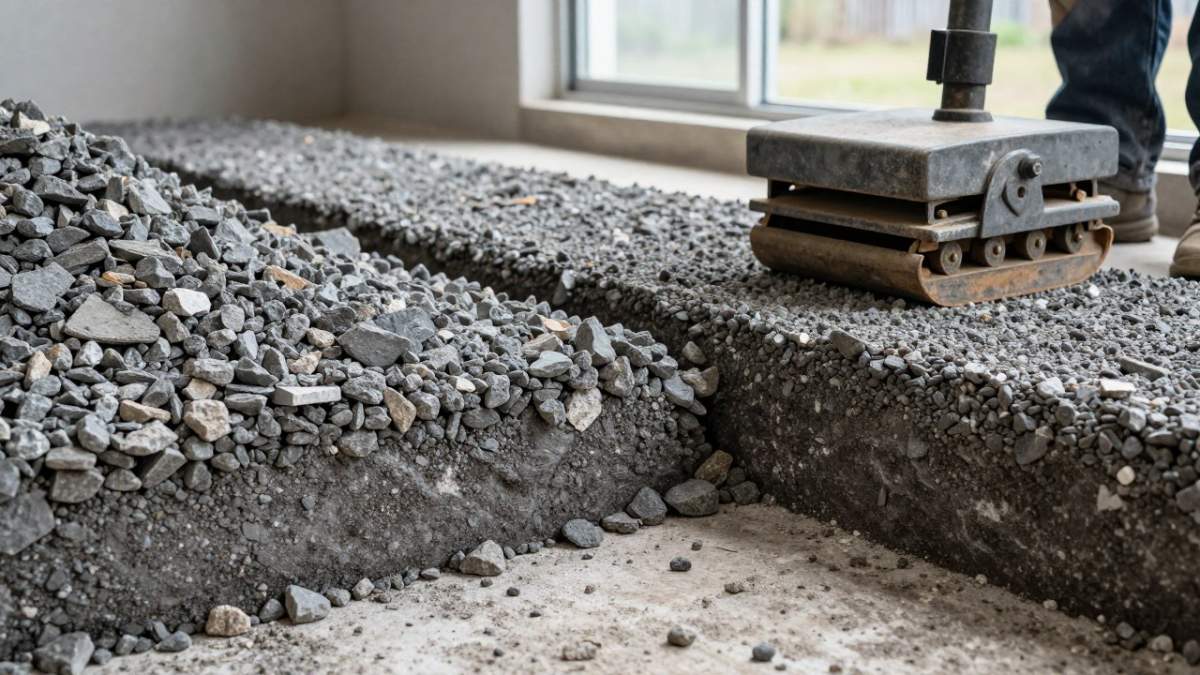
Crusher run is crushed stone mixed with fines, and it makes an excellent driveway base because it compacts into a hard, stable layer. It is one of the most economical options for a firm roadway that has to carry vehicle loads. The trade-off is drainage: crusher run holds more water than an open-graded material, so it suits well-drained ground better than a waterlogged site.
Other options worth knowing:
- Graded crushed stone: clean, angular stone graded to a controlled spread of sizes, so it compacts densely and is a reliable load-bearing base.
- Limestone and granite chippings: angular choices for a base layer.
- Recycled concrete aggregate: a sustainable option where grading is consistent.
- Ballast and sand: usually blended for concrete, not a base on their own; sand alone has no interlock and will migrate under load.
Think about these options by grading rather than by name. A well-graded material compacts dense; an open-graded material drains better but stays looser.
Once you have picked your aggregate, the next step is getting a quote for aggregate delivery.
Driveway Sub-Base Depth and How Much Aggregate for a Driveway
A typical driveway sub-base is 100-150mm deep for domestic use, and around 200mm where heavier vehicles will park. The exact depth depends on your subgrade and soil.
To work out how much aggregate you need, multiply length by width by depth in metres, then use your supplier's stated density for the material you choose.
Ground preparation matters as much as the material. Excavate to depth, lay a geotextile membrane to stop fines mixing with the subgrade, then compact in layers. Skipping the membrane is the most common cause of rutting and muddy ground later.
If you would rather not work the sums by hand, this guide to calculating aggregate needs for construction walks through the quantities step by step.
Choosing the right aggregate is only half the job. The other half is getting it on site, on time, at the right quantity, without a late delivery stalling your project. SA GRAB SERVICES supplies Type 1 MOT, crusher run and graded stone with delivery or depot collection, and we handle muck away and groundworks on the same job so you are not coordinating three firms. Get started with SA GRAB SERVICES and build a driveway base that lasts.
Frequently Asked Questions
Is MOT Type 1 suitable for a driveway sub-base?
Yes. MOT Type 1 is the standard choice for a driveway sub-base because its graded mix of crushed stone and fines compacts into a firm, load-bearing layer. It locks together under a roller or plate compactor and spreads vehicle loads into the ground below. Deeper build-ups suit heavier vehicles or softer ground. Confirm the depth with your supplier before ordering, as quantities and delivery vary by site.
How deep should a driveway aggregate base be?
A domestic driveway base is usually 100-150mm of compacted Type 1 or crusher run over a geotextile membrane. Ground conditions decide the final figure. Soft clay or muddy ground needs more excavation and a thicker layer, sometimes 200mm or more, while firm subsoil may take the minimum. The base must sit above the water table and fall away for drainage. Under block paving, allow for a separate sharp sand bedding layer on top of the compacted base.
How much aggregate do I need for a driveway base?
Work out volume in cubic metres: length x width x depth. A 40 square metre driveway at 150mm needs 6 cubic metres. Multiply by roughly 1.6 to 1.8 tonnes per cubic metre for compacted crushed stone, so around 10 to 11 tonnes. Add 10% for compaction and wastage. Give your supplier the measurements and they can convert to tonnes and check delivery access, since grab lorries need room to reach the drop point.