 how-to
Calculating Aggregate Needs for Construction Made Simple
Last Updated: October 28, 2026
Quick Summary
To calculate aggregate needs, multiply length by width by depth in metres to get cubic metres, then add an allowance for compaction and wastage. Convert the final volume to tonnes by multiplying it by the material's density in tonnes per cubic metre.
- Convert depths in millimetres to metres before calculating, as a 100mm depth becomes 0.1m.
- Add around 10% for compaction, since loose aggregate settles and shrinks when rolled or trafficked.
- Use an aggregate calculator as a cross-check, not a replacement for your own measurements.
- For a driveway sub-base, allow roughly 100mm depth of MOT Type 1 plus 15% for compaction and wastage.
- Take length and width at the widest points and depth at several spots, because ground is rarely level.
Table of Contents
- How to Calculate Aggregate Volume for Any Site
- Using an Aggregate Calculator to Check Your Figures
- Aggregate Density Tonnes per Cubic Metre Explained
- How Much Aggregate Do I Need for a Driveway?
- What Measurements to Take Before Ordering Aggregate
- Ordering the Right Aggregate Quantity for Your Project
- Frequently Asked Questions
How to Calculate Aggregate Volume for Any Site
Getting your aggregate needs wrong is one of the most expensive mistakes on a building job. Order too little and you pay for a second delivery plus lost time. Order too much and you are stuck with a pile of gravel you cannot shift. This guide shows you the straightforward maths for calculating aggregate volume.
Aggregate needs are the total volume of gravel, sand, crushed stone or topsoil a project requires, measured in cubic metres before compaction. Getting that figure right comes down to one formula, one wastage allowance, and a check against density.
The core formula: length x width x depth
Every volume calculation starts here:
Volume (m³) = length (m) × width (m) × depth (m)
Measure in metres, not millimetres. A 100mm depth becomes 0.1m in the sum. That single conversion is where most errors creep in.
For a driveway 10m long, 4m wide and 100mm deep:
- 10 × 4 × 0.1 = 4 cubic metres
Irregular shapes? Split the area into rectangles, work out each one, then add the totals together.
Adding an allowance for compaction and wastage
The raw volume is never the amount you order. Two things eat into it:
- Compaction: loose aggregate settles and shrinks when rolled or trafficked. A common approach is to add around 10%.
- Wastage: spillage, uneven ground and offcuts.
Using an Aggregate Calculator to Check Your Figures
An aggregate calculator is a quick online tool that converts your length, width and depth into cubic metres and tonnes. Use it as a cross-check, not a replacement for your own measurements.
Here is how to use one:
- Enter your dimensions in metres.
- Select the material type so the tool applies the right density.
- Add your wastage percentage.
- Compare the result against your hand calculation.
If the two figures diverge, recheck your depth conversion first.
Aggregate Density Tonnes per Cubic Metre Explained
Suppliers sell aggregate by the tonne, but you calculated in cubic metres. Density bridges the gap.
Aggregate density is the weight of one cubic metre of material, expressed in tonnes per cubic metre (t/m³).
The sum is simple: Tonnes = Volume (m³) × Density (t/m³).
Typical density figures for common aggregates
| Aggregate type | Typical density (t/m³) | Common use |
|---|---|---|
| Sharp sand | 1.6 | Screeds, bedding |
| Ballast | 1.7 | Concrete mixes |
| MOT Type 1 | 2.0 | Sub-base, driveways |
| Gravel (20mm) | 1.6 | Decorative surfacing |
| Topsoil | 1.3 | Garden and lawn prep |
How Much Aggregate Do I Need for a Driveway?
For a standard driveway sub-base, work on roughly 100mm depth of MOT Type 1, plus a 15% allowance for compaction and wastage. That works out at about 0.115m³ per square metre.
Worked example: a 40 square metre driveway
Run the numbers step by step:
- Area: 40m²
- Depth: 0.1m
- Raw volume: 40 × 0.1 = 4m³
- Add 15%: 4 × 1.15 = 4.6m³
- Convert to tonnes: 4.6 × 2.0 = 9.2 tonnes
What Measurements to Take Before Ordering Aggregate
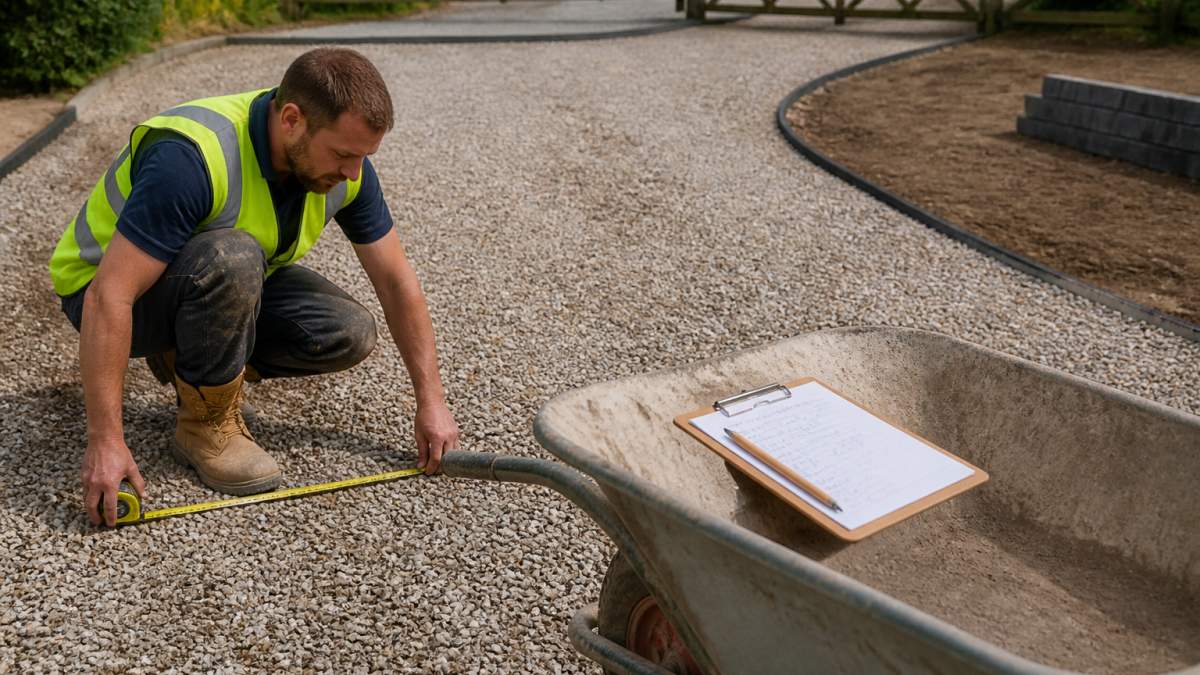
Accuracy starts with the tape measure. Take these readings:
- Length and width at the widest points, in metres.
- Depth at several spots, because ground is rarely level.
- Access route width and any gate or overhead clearance.
- Ground conditions, noting soft spots or slopes.
- Drainage falls, so the finished level sheds water.
Write everything down.
Ordering the Right Aggregate Quantity for Your Project
Ordering is where your careful maths pays off. Give the supplier the tonnage, the material type and the delivery date, and confirm the access details at the same time.
If you are working on a residential site and want the material delivered and the spoil taken away in one visit, see how to use grab hire for residential projects. It keeps a tight site clear without stacking skips.
At SA GRAB SERVICES, we supply aggregates and handle muck away, with delivery or depot collection. We also offer grab hire and groundworks services. Get started with SA GRAB SERVICES.
Frequently Asked Questions
How do you calculate how much aggregate you need?
Measure the length, width and depth of the area in metres, then multiply them together to get the volume in cubic metres. Multiply the volume by the aggregate density in tonnes per cubic metre to get the tonnage to order.
How do you convert aggregate volume into tonnes?
Multiply the volume in cubic metres by the aggregate density in tonnes per cubic metre.
How much extra aggregate should I allow for compaction and wastage?
A 10 per cent allowance covers most situations. Type 1 sub-base and similar graded materials compact by roughly 5 to 10 per cent once rolled, and you will lose a little to spillage, uneven ground and over-dig. On tight sites or where the sub-grade is soft, go to 15 per cent. Ordering slightly over is cheaper than a second delivery mid-project.
How much aggregate do I need for a driveway?
For a standard driveway sub-base, work to a compacted depth of 100mm to 150mm of Type 1, depending on traffic. A 40 square metre drive at 100mm needs 4 cubic metres, or about 4.4 cubic metres with the compaction allowance, which is roughly 7 tonnes at 1.6 tonnes per cubic metre. Heavier vehicles and softer ground push the depth towards 150mm.