 How-to
Why professional groundworks prevent drainage aresues
Last Updated: November 7, 2026
Quick Summary
Professional groundworks prevent drainage issues by setting correct ground levels and falls, placing pipes at the right depth and gradient, and compacting the ground so it does not settle or hold water. This work happens before any pipe is laid, so mistakes stay hidden until they surface as damp, settlement or standing water.
- Site preparation starts with assessing soil conditions and ground levels before excavation.
- Test the drainage run before backfill so faults are not buried.
- Backfill and compact in layers to stop the ground settling around the pipe.
- Backfilling a trench before testing is the most costly groundwork mistake.
- Trenches backfilled with rubble or clay block water movement and cause siltation.
Table of Contents
- Why professional groundworks prevent drainage issues
- Common drainage problems on building sites
- Site preparation for drainage: what has to happen before a pipe goes in
- Groundwork mistakes that cause surface water drainage problems
- Frequently Asked Questions
Why professional groundworks prevent drainage issues
Water always finds the low point. If that low point is under your new extension or beside your footings, you have a problem that costs far more to fix than it did to prevent. This is the core reason why professional groundworks prevent drainage issues: the work that decides whether a site drains well happens before any pipe is laid, and it happens below ground where mistakes stay hidden until they surface as damp, settlement or standing water.
Professional groundworks is the site work done before and during construction that sets levels, prepares the ground and installs drainage so water moves away from buildings rather than into them.
Good groundworks do three things well:
- Set correct ground levels and falls so water runs where it should
- Place drainage pipes at the right depth and gradient
- Prepare and compact the ground so it does not settle or hold water
Get those right and many drainage problems can be avoided. Get them wrong and you inherit blocked drains, saturated soil and a slow, expensive fight against water.
Common drainage problems on building sites
Drainage problems on building sites can come from poor preparation as well as from the pipes themselves. Waterlogging, standing water and blocked drains can trace back to levels that were not set correctly or soil that was not assessed.
Watch for these on any site:
- Standing water in excavations after rain, which points to poor falls or no outfall
- Siltation in new pipes because trenches were not cleaned before backfill
- Saturated soil around footings, which weakens foundation stability over time
- Blocked drains from debris left in the system during the build
Site preparation for drainage: what has to happen before a pipe goes in
Site preparation for drainage starts with an assessment of soil conditions and ground levels, then excavation to the right depth and fall before any pipe is placed. Skip that sequence and the drain is only as good as the guess behind it.
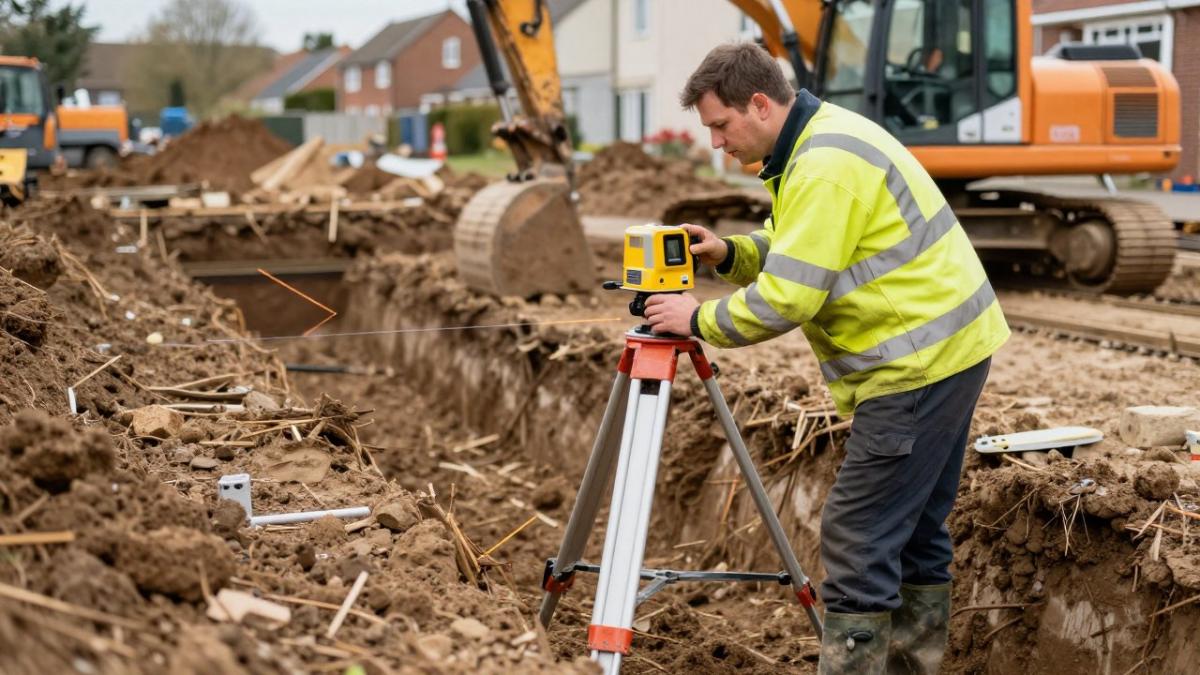
A typical order for drainage work on site is:
- Assess the ground. Check soil type, permeability and where water currently sits.
- Set ground levels and falls. Work out the gradient that takes water to the outfall.
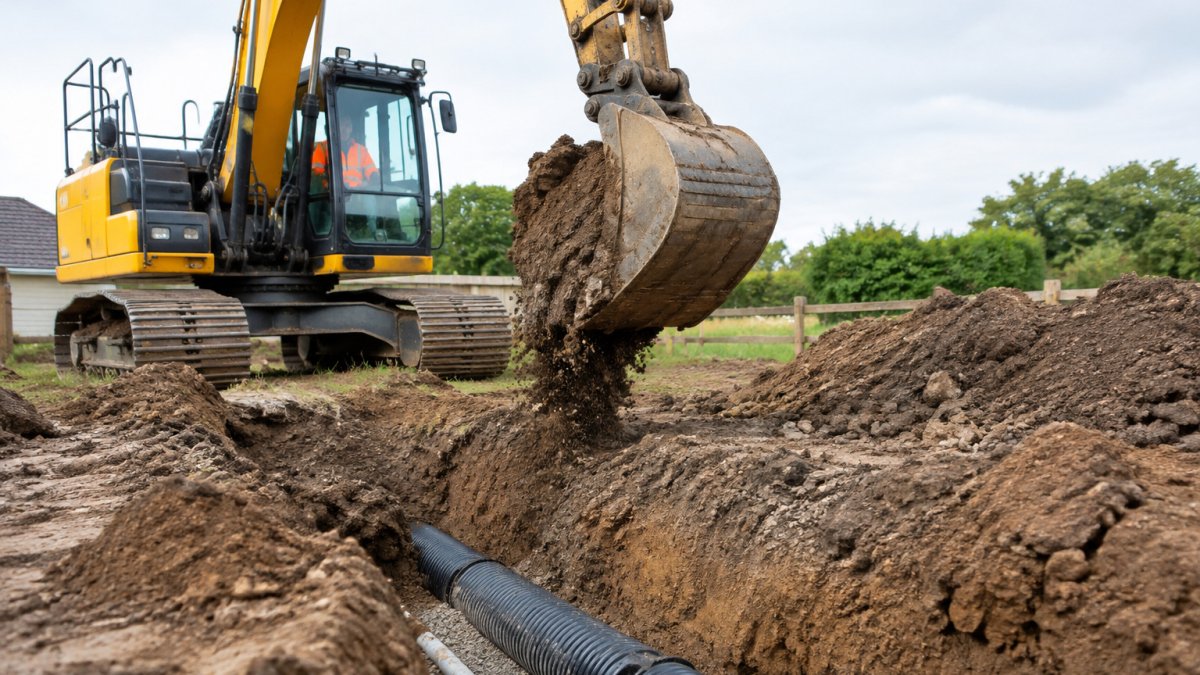
- Excavate trenches to the correct depth and line, keeping the base clean.
- Place and connect the pipes at the right gradient, with the right fall throughout.
- Test before backfill. Check the run holds and flows before you cover it.
- Backfill and compact in layers so the ground does not settle around the pipe.
If you are weighing up whether to bring in a contractor for the wider site work, it helps to understand the benefits of professional groundworks services before you commit, because the drainage is only one part of what good preparation protects.
A typical order for drainage work on site runs through these steps.
| Step | What to do |
|---|---|
| 1 | Assess the ground: soil type, permeability, where water sits |
| 2 | Set ground levels and falls to the outfall |
| 3 | Excavate trenches to correct depth and line, keep base clean |
| 4 | Place and connect pipes at the right gradient and fall |
| 5 | Test before backfill that the run holds and flows |
| 6 | Backfill and compact in layers to prevent settlement |
Groundwork mistakes that cause surface water drainage problems
Groundwork mistakes that cause surface water drainage problems are almost always the same few, repeated. The most damaging is getting the falls wrong, so water sits instead of running to the outfall.
The others we see most often:
- No early drainage assessment, so the design is bolted on after levels are fixed
- Trenches backfilled with rubble or clay, which blocks water movement and causes siltation
- Pipe gradients that are too shallow, which lets water pool and solids settle
- No plan for runoff, so surface water collects against the building
- Skipping the test before backfill, so a fault stays buried until it floods
Watch out: backfilling a trench before testing the run is the mistake that costs the most. A fault you cannot see becomes a blocked drain you cannot reach without digging it all up again.
Surface water drainage works best when it starts with the ground, not just the pipe. Correct levels, clean trenches, the right fall and a tested run all help keep water moving away from the building.
If water is already pooling on your site or you are about to break ground, the cheapest moment to get the groundworks right is now. SA GRAB SERVICES handles muck away, aggregate supply and professional groundworks across the region, with digger hire and a driver, delivery or depot collection, and drainage work built into the job rather than bolted on. Get started with SA GRAB SERVICES and prepare the site once, properly.
Frequently Asked Questions
How do groundworks affect drainage?
Groundworks set the levels, falls and soil conditions that a drainage system depends on. If the excavation is too shallow, the pipe falls are wrong or the trench backfill is poorly compacted, water cannot move away and sits in the ground. Professional groundworks get these details right before pipes are laid, which is why fewer systems fail, block or flood after the build is finished.
What causes drainage problems on building sites?
The usual causes are incorrect pipe gradients, silt and debris left in trenches, poorly compacted backfill, and no allowance for how the soil drains. Saturated soil and standing water then load the system beyond its capacity. A proper site assessment and early drainage assessment catch these risks before excavation begins, rather than after waterlogging appears.
When should drainage be considered during a construction project?
At the site assessment stage, before any excavation starts. Early drainage assessment lets you check soil conditions, permeability, ground levels and the outfall, then design falls and pipe placement around what the ground actually does. Leaving drainage until after foundations are in usually means rework, construction delays and a system that struggles in wet weather.