 ultimate-guide
The Builder's Guide to Legal Waste Disposal
Last Updated: 2 November 2026
Quick Summary
Legal waste disposal for builders means storing waste safely, transferring it only to authorised carriers, and keeping a documented paper trail from site to a permitted destination. The duty of care stays with you as the waste producer, even after the skip has left your yard.
- Run five checks before any load leaves: carrier registration, permitted site, transfer note, EWC code and retained copies.
- Write your site waste management plan before work starts and update it as the project evolves.
- Describe waste specifically on the transfer note, such as mixed construction waste: brick, timber offcuts, plasterboard, soil.
- Keep plasterboard separate and never mix it with biodegradable waste in a skip.
- Book only with a carrier who shows registration and issues a transfer note for every load.
Table of Contents
- What Legal Waste Disposal for Builders Actually Requires
- Your Builder Waste Duty of Care in Plain Terms
- How to Write a Construction Site Waste Management Plan
- The Waste Transfer Note in Construction: What to Keep and for How Long
- Common Builder Waste Types and How to Dispose of Each
- Skip or Grab Lorry for Building Waste: Choosing the Right One
- Separating and Storing Waste on Site Without Breaching the Rules
- What Happens If You Get Waste Disposal Wrong
- Booking Compliant Waste Removal for Your Next Project
- Frequently Asked Questions
What Legal Waste Disposal for Builders Actually Requires
Legal waste disposal for builders is the documented, traceable handling of construction waste from the moment it leaves site to its final, permitted destination. It rests on three pillars: a duty of care, a written waste management plan, and a paper trail that survives inspection. This guide from SA GRAB SERVICES breaks down exactly what each one demands.
Most builders get caught out not by fly-tipping themselves, but by handing waste to someone who does. That is the trap the rules are designed to close, and it is where the fines land.
Below, we walk through the duty of care, the paperwork inspectors ask for, how to separate and store waste on site, and how to book compliant removal that keeps your name clean. The rules come from the Environment Agency's waste duty of care guidance, which applies to every business that produces, carries, keeps, treats or disposes of waste.
Your Builder Waste Duty of Care in Plain Terms
Your builder waste duty of care is a legal obligation to ensure waste is stored safely, transferred only to authorised carriers, and accompanied by the correct documentation. It applies from the moment waste is created until it reaches a licensed site, and it stays with you even after the skip has left your yard.
The duty of care sits with the waste producer, which is you. It does not transfer to the person who collects it. If your waste ends up dumped in a layby, the regulator will trace it back through the paperwork to your site.
The five checks that keep you compliant
Run these before any load leaves your control:
- Check the carrier holds a valid waste carrier, broker or dealer registration
- Confirm the receiving site is permitted to accept that waste type
- Complete a waste transfer note with a full written description
- Record the European Waste Catalogue code for each waste stream
- Keep copies for the required retention period
Watch out: the single most common failure is skipping the carrier registration check because "they've always been fine." A legitimate-looking firm can lose its registration, and the waste becomes yours to answer for.
How to Write a Construction Site Waste Management Plan
A construction site waste management plan is a written document setting out the waste types a project will produce, how each will be separated and stored, who will remove it, and where it will go. It is required on larger projects and expected as good practice on all of them.
Write it before work starts. The plan should name the waste streams you expect, estimate volumes by type, identify the storage locations on site, and list the permitted facilities receiving each stream. Review it as the project evolves. Inspectors treat a plan that has never been updated as evidence that nobody is managing waste at all.
Keep it practical. A one-page plan that site staff actually read beats a fifty-page document nobody opens. The plan should connect directly to your duty of care obligations, so the two documents tell the same story.
The Waste Transfer Note in Construction: What to Keep and for How Long
A waste transfer note in construction is the written record that accompanies every transfer of waste from one party to another. It must describe the waste accurately, identify both parties, state the permitted destination, and be signed by both sides.
The description matters more than builders expect. "Builders waste" is not a description. "Mixed construction waste: brick, timber offcuts, plasterboard, soil" is. Vague descriptions are one of the first things an inspector challenges, because they make it impossible to prove where waste went.
Keep copies for the required retention period. Store them somewhere you can find them within minutes, not in a shoebox in the van. Digital copies are fine and are far easier to produce during an inspection. If you use a grab hire or skip service, confirm the transfer note is issued for every load, not just the first one.
Common Builder Waste Types and How to Dispose of Each
Different waste streams carry different rules, and treating them all as one mixed load is where compliance breaks down. Here is how the main types should be handled:
| Waste type | Storage approach | Disposal route |
|---|---|---|
| Soil and subsoil | Separate pile, away from drainage | Reuse on site or remove as inert waste |
| Brick and concrete rubble | Hardstanding area, contained | Inert waste facility or recycling |
| Timber offcuts | Covered skip, kept dry | Recycling or energy recovery |
| Plasterboard | Separate, never mixed with biodegradable waste | Dedicated plasterboard recycling |
| Packaging and plastic | Segregated bins | Recycling stream |
| Hazardous items (paints, solvents) | Locked, labelled container | Licensed hazardous waste contractor |
Plasterboard is the stream most often mishandled. It cannot go into a mixed skip with biodegradable waste, and it needs its own container. Hazardous waste needs a separate consignment note and a contractor licensed for it, so plan that removal early rather than discovering it mid-project.
Skip or Grab Lorry for Building Waste: Choosing the Right One
The choice between a skip and a grab lorry comes down to where the waste sits and how much space you have. A skip suits waste you can carry to a fixed container at the front of the property. A grab lorry suits waste already piled on a driveway or garden, where a vehicle can reach it and lift it directly.
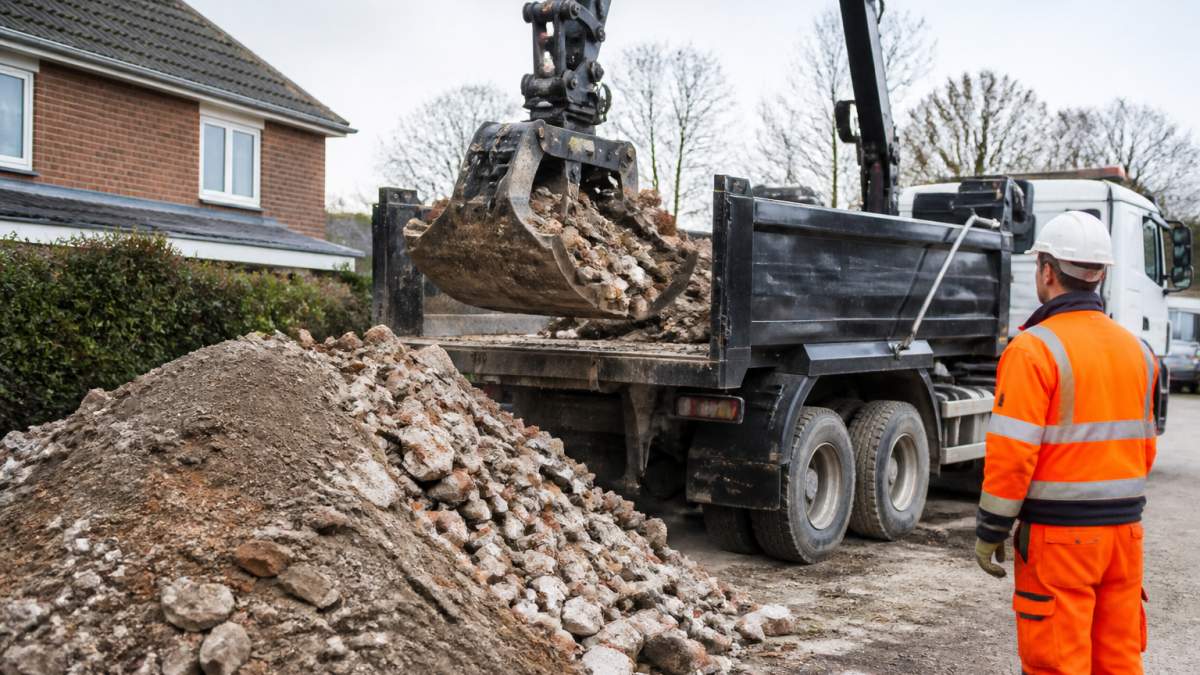
Grab hire removes the double handling. How to use grab hire for residential projects covers the practical steps. You pile the waste where it is generated, and the lorry lifts it without anyone wheeling barrows to a skip. On tight residential jobs, that saves hours and keeps the site clearer. Skips still make sense where waste is generated continuously across a large site and needs a permanent collection point.
Before you decide, it helps to understand how access, load weight and distance affect the quote. Pricing depends on quantity, dates and delivery, so check SA GRAB SERVICES's website for current prices or a quote.
Separating and Storing Waste on Site Without Breaching the Rules
Segregation on site is not just good practice, it is what makes the rest of your paperwork believable. Mixed waste is harder to describe accurately, harder to send to the right facility, and more expensive to dispose of.
Set up clearly labelled containers for each stream before work begins. Keep hazardous waste locked and away from drainage. Cover skips so rainwater does not turn dry waste into a contaminated slurry that no facility will accept. Keep soil piles away from drains and boundaries.
A common mistake is letting the whole team use one skip "just for now." Within a week it holds everything, and your transfer note can no longer describe it honestly. Assign one person to police segregation, and make it part of the site induction.
What Happens If You Get Waste Disposal Wrong
Getting waste disposal wrong exposes you to enforcement action, from fixed penalties to prosecution, and the duty of care follows the waste back to the producer. The regulator can act against builders who fail to check carriers, keep records, or describe waste accurately.
The reputational cost often stings more than the fine. How contractors avoid waste disposal fines explains the checks that keep penalties away. A contractor known for fly-tipped loads loses tenders.
Watch out: "I didn't know where they took it" is not a defence. The law places the check on you, and inspectors start with the paperwork you were required to keep.
Booking Compliant Waste Removal for Your Next Project
Compliant removal starts with a simple habit: book only with a carrier who can show you their registration and issue a proper transfer note for every load. Ask before you book, not after.
At SA GRAB SERVICES, we handle muck away and waste removal, with grab hire and aggregate supply available as a single coordinated service. Materials and waste removal can be planned around your programme.
Contact SA GRAB SERVICES for current prices or a quote, and keep your next project's waste documented and traceable.
Frequently Asked Questions
What are a builder's legal responsibilities for construction waste?
Under the duty of care rules, you must store waste safely, prevent it escaping, and hand it only to a registered waste carrier. You need to check that carrier's registration, keep a waste transfer note for every load that leaves site, and record where it went. You also need to separate waste where required and keep hazardous items apart. Failing these steps can lead to enforcement action, so it is worth building the checks into your routine on every job.
How can builders check whether a waste carrier is registered?
Ask for the carrier's registration number and check it against the public register held by the environmental regulator before any waste leaves site. Record the number on the waste transfer note. A legitimate carrier will give the number without hesitation. If someone turns up offering a cheap clearance and cannot produce a registration number, walk away, because the waste becomes your responsibility if it is fly-tipped, and the fine lands on you rather than them.
What records must builders keep when waste leaves a site?
Keep a waste transfer note for each load, signed by you and the carrier, describing the waste type, quantity, and destination. Keep these for the required retention period. If you produce, store, or transport hazardous waste, you also need consignment notes and must register as a hazardous waste producer. Store copies digitally or in a folder on site so an inspector can see them without a scramble.
Can builders take construction waste to a household recycling centre?
Generally no. Household recycling centres are funded for domestic waste only, and most will turn away trade waste or charge separately for it. Turning up with a van full of rubble from a paid job can result in refusal or a penalty. Use a licensed waste transfer station, a grab lorry service, or a skip from a registered provider instead, and make sure the destination is authorised to accept commercial construction waste.
Is a skip or grab lorry better for building waste?
It depends on the job. A skip suits sites where space is tight and waste builds up gradually, and it stays put for days or weeks. A grab lorry is better for heavy muck, soil, rubble, and one-off clearances, because it loads itself and leaves the same day, so you avoid a permit for a skip on the road. For larger projects, many builders use both: a skip for mixed light waste and a grab lorry for heavy arisings.
What happens if a builder disposes of waste illegally?
Penalties can include enforcement action and prosecution. You can be held responsible even if you paid someone else to take the waste, if you failed to check they were registered. Beyond the fine, illegal disposal can affect your ability to win contracts that require evidence of compliant waste management, so the commercial damage often outweighs the penalty itself.